Essay10 min read
Build the house. Open the saucer.
Engineering · Reverse Engineering · Software · Learning · Thinking · Systems
You can walk a program from a requirement down to a binary, or from a binary back toward a design. Same road, two directions. A beginner essay on why you should practice both—including when the point is a flaw or a piece of malware.
If you only know how to build, you will believe finished objects too easily. If you only know how to take apart, you will not ship anything new. A learner who wants to stay honest about machines has to practice both.
That is not two hobbies and not a personality split. It is one road you can walk down (intent → artifact) or up (artifact → intent). Skip a direction and you are working with half a method.
This is an opinion, written as a lecture. You do not need to become a malware analyst this week. You do need to drop the line that “real engineers only write new code.”
One-sentence crystal
Constructive (forward) engineering turns a need into something that runs. Reverse engineering turns something that already runs back into a need you can name. You need both: most houses you will touch, you did not draw.
The two arrows
Constructive (forward):
  Requirements  →  Design  →  Source code  →  Executable / service

Reverse:
  Executable / packet / file  →  Disassembly or decompilation
        →  Recovered logic  →  High-level design (a hypothesis)
Constructive engineering (also called forward engineering) starts abstract: “I need a program that counts lines.” It ends concrete: bytes the machine will run.
Reverse engineering starts with something already concrete—a compiled program, a file format, a network conversation—often with no source and no trustworthy manual. You work upward until you can say, with evidence, how it behaves and what problem it was built to solve.
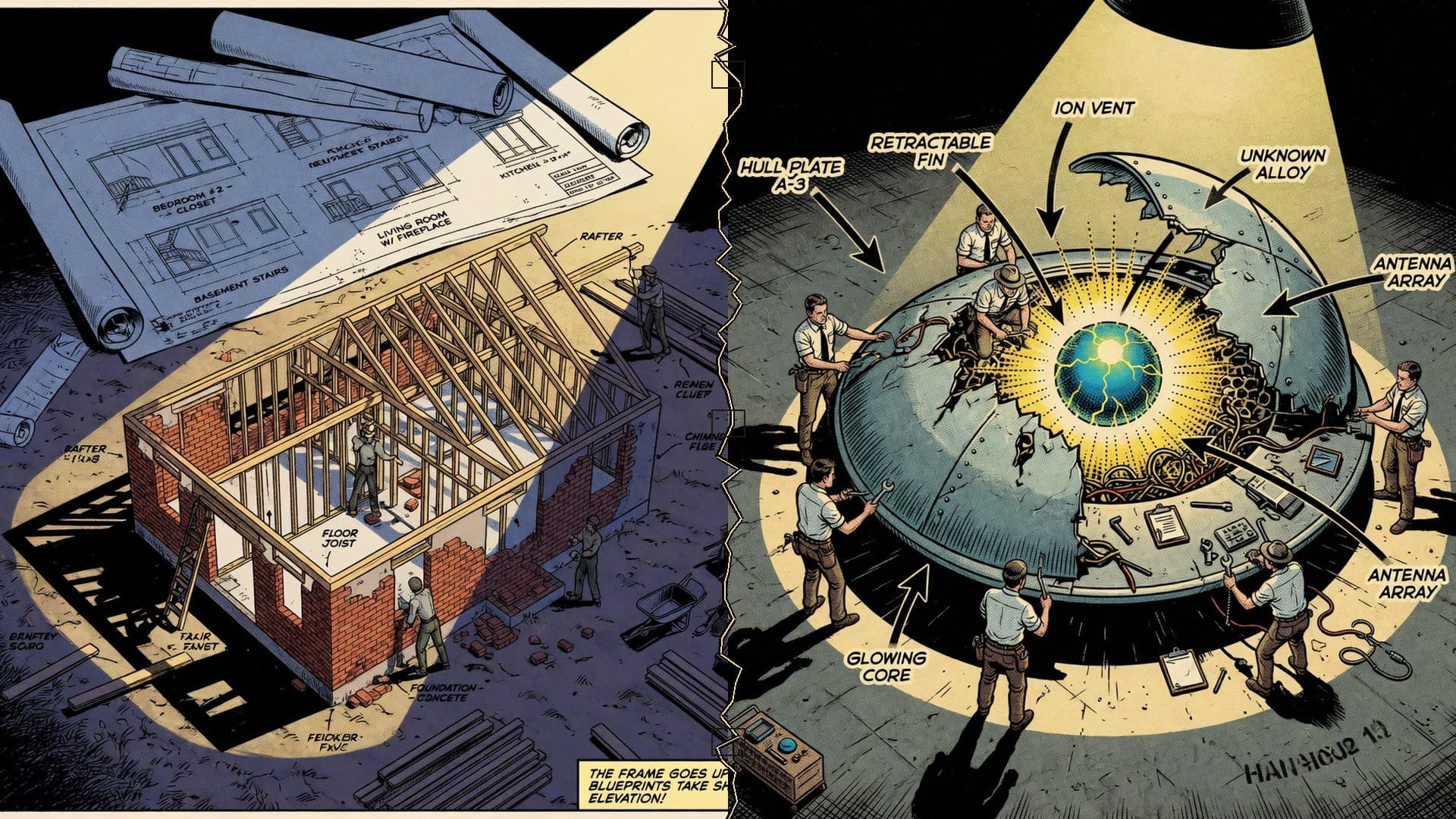
The cover uses a house and a saucer. The house is a plan you execute. The saucer is already flying; nobody invited you to the design review; you still need a map of the engine.
| Constructive | Reverse | |
|---|---|---|
| Arrow | Top-down: abstract → concrete | Bottom-up: concrete → abstract |
| Start | Problem, need, spec | Binary, protocol, leftover box |
| Goal | Create a working product | Understand, document, modify, or interoperate |
| Tools | Editor, compiler, tests, git, CI | Disassembler, debugger, sniffer, hex |
| If you only do this | Rewrite from scratch when anything is opaque | Endless notes, nothing shipped |
| Beginner gym | Tiny programs with tests | Your binary: file, strings, objdump / ltrace |
Constructive engineering, without romance
You have done this if you have ever written a script from a homework prompt.
- Name the requirement. What must be true when you stop?
- Design the smallest structure that could work. A file? A loop?
- Write source the machine (or an interpreter) will accept.
- Build and test until the artifact matches the requirement—or change the requirement honestly.
Survey, plan, foundation, frame, weatherproofing, inspection. You do not start by staring at a finished roof and guessing the joist spacing. You place the joists.
What you get from this: naming, tests, a definition of “done.” You learn to keep a promise.
What you do not get: practice reading a world that did not keep you a promise. Most software you will touch did not appear this morning from your editor. It arrives as a binary, a container, a protocol, a legacy script with no author in the building. Face a mysterious failure with only construction in your hands and the expensive move is always the same: throw it out and rewrite.
Reverse engineering, without mystique
You have already done a kind of reverse work if you have ever explained someone else’s function, inferred a service from its config, rebuilt a story from strace or a log, or opened a packet capture because you wanted the bytes, not the slide.
Professional work on binaries uses heavier instruments. A disassembler (Ghidra, IDA, and kin) turns machine code into assembly. A decompiler guesses at higher-level logic. A debugger (gdb, WinDbg, x64dbg) lets you stop time and watch registers. Packet work uses sniffers. File formats use hex and, when the official spec is missing, a spec you write yourself.
Three steps:
- Obtain a specimen you are allowed to study.
- Lift it one layer: machine code → assembly or pseudo-C; packets → fields.
- Map behavior. Name things. Write the design that must have existed.
On the hangar floor the craft works and the builders are not taking questions. You pull hull plates, label a glowing core, and produce drawings. Those drawings are hypotheses. You test them by predicting the next bolt.
This trains a ledger: evidence over folklore, patience with ugly names, respect for invariants (what cannot be true if the thing still runs). It does not, by itself, teach you to specify a house that should exist. Stay here too long and you become a tourist of other people’s engines—sharp on how, mute on whether we should build.
Same arrow, different questions
The bottom-up method is not one job. What you ask the artifact decides whether the work is documentation, interop, defense, or offense. The hangar is the same. The clipboard is not.
Beginners hear “offense” and “malware” and either romanticize them or run. Both are reverse engineering. Neither is a personality.
Offensive support: find the flaw, then prove it
In authorized testing, vulnerability research, or an exploit lab you are allowed to break, reverse engineering is how you find a weakness. You do not start from marketing. You start from a binary, a service, or a protocol, and lift until you can say: this check can be made false; this length is trusted; this path is reachable from the network.
Writing the smallest artifact that demonstrates that sentence is then constructive. Reverse found the claim. Construction is the test a vendor cannot wave away. “I think this is exploitable,” with no case, is commentary. “Rewrite the whole thing,” with no reverse pass, never finds where the house is already on fire.
Defensive support: name what the sample can do
On the defensive side the same arrow is used on malware. The goal is rarely “make it run better.” The goal is to name capabilities (what the sample can actually do):
| Question | Why it is reverse work |
|---|---|
| What can it read, write, or send? | Recovered I/O, not a vendor datasheet |
| How does it persist and hide? | Control flow and artifacts on disk |
| What breaks if we block X? | Invariants: what it must do to finish |
| Same family as last month? | Shared design recovered from two concretes |
The UFO is hostile. Your drawings are a capability brief. Construction still shows up: detectors, YARA-like rules, hunt queries, containment scripts—houses you build because the saucer was mapped.
| Offensive-leaning | Defensive-leaning | |
|---|---|---|
| Specimen | Our product, or a target we may test | Their implant, dropper, lure |
| Success | A reachable weakness, shown | A named set of behaviors, shown |
| You still have to build | Proof of concept, patch, regression | Detection, hunt, playbook |
| Ethics failure | Unauthorized break, or a “demo” that is a crime | Spreading the sample; guessing in public |
Do not flatten this into “hackers vs blue team.” Every serious question about an opaque artifact is reverse. Every useful answer eventually becomes a constructed check.
Why both
Construction without reverse is faith. A library fails. A protocol misbehaves. A vendor box returns 0x80004005. If your only move is “write more of my code,” you are arguing with a ghost. Reverse skill is permission to ask the artifact questions and accept the answers it actually gives. The terminal lecture is reverse work on a stack you already use. You did not invent n_tty. You opened a daily tool.
Reverse without construction is commentary. “I think this packet is a length-prefixed string” is idle until you write a parser and the next capture does not break it. “This sample looks like a stealer” is idle until a detector fires on the next cousin. Offense and defense both end in something you built, or they stay tourism.
Each direction audits the other. After you build, reverse your own output: the assembly of your hello, your HTTP in a sniffer. You will see what the compiler discarded and what your “simple” function became. After you reverse, rebuild a sliver—a tiny compatible encoder, a test that fails if the format changes. Reconstruction is the exam. Reading is only the lecture.
No serious Tuesday is only greenfield. You inherit a blob, a YAML dialect, a unit file you did not write, a firmware, a format from 1998. You also add a script, a test, a wrapper. The day is a braid. Train only one direction and you are training for a job that does not exist.
Construction alone breeds arrogance (“I would have designed it better”) with no evidence. Reverse alone breeds passivity (“everything is someone else’s maze”). Together you get a rarer habit: I can make, and I can be taught by what already exists. That is the opinion.
How a beginner trains both
Do not start with nation-state malware. Start authorized, small, and two-way.
House. Write a program that solves a stated problem (count words; parse a tiny config). Add a test that would fail if you lied. Change a requirement on purpose and feel the cost of a sloppy first spec.
Saucer. Take your compiled program. Run file, strings, nm or objdump -d (or the equivalent on your OS). Find the function you wrote. Three sentences: what survived, what the compiler invented, what you cannot see. If it talks to the network or a file, write the format down as if you had lost the source. Later: an open binary or a classroom crackme, with a notebook of hypotheses. Still later, and only in a legal classroom or job: a vulnerability lab, or a malware sandbox (name capabilities; do not play on the laptop that holds your life). The purpose changes. The three reverse steps do not.
Once a week is enough: build one small tested feature; reverse one artifact you did not write today (a unit file, a log, a hex dump of your own output); change the feature because reverse work found a lie. Skip the loop and you are collecting hobbies.
Ethics
Reverse engineering is a power. Powers have gates.
Prefer your code, open licenses, written permission, or explicitly legal research targets. Offensive reverse work without authorization is not “practice.” Malware work needs isolation—a dedicated, disposable environment. “I could open it” is not “I may publish a crack, an exploit, or the sample.” Interoperability and security research have legal doctrines that vary by country. When unsure, stop and ask a supervisor or counsel, not a tutorial comment section.
You can also build harmful systems with a clean compile. Direction does not confer virtue. Purpose does not either. The ledger does.
The saucer metaphor is for opacity, not trespass.
Closing
The industry likes “builders” and “breakers” as if that were a personality test. I reject the split as a curriculum.
Keep a promise from sentence to binary. Extract a sentence from a binary that never introduced itself—whether that artifact is yours (find the flaw) or someone else’s (name what it can do).
Do both until Tuesday feels like the same craft facing either way.
Open edge: Once you can walk both arrows, what evidence tells you, on a given morning, to build a spike first—or to open the specimen first?