Opinion7 min read
Why “shift-left testing” matters
Testing · Quality · Process · CI · Opinion
Shift-left is not a slogan for earlier panic—it is a design choice about when feedback is cheap. Why moving tests left of late integration reduces rework, and where the phrase gets abused.
“Shift-left testing” is one of those phrases that shows up on slides long before it shows up in habits. Teams chant it, buy a tool labeled with it, and still discover the real bug three days before release—when every fix is political, expensive, and half-understood.
This opinion is not a methodology catechism. It is a working claim:
Shift-left matters because the cost of learning that something is wrong usually rises as you move right on the delivery timeline—and because tests are one of the few feedback loops you can deliberately place earlier.
What follows is definition, why the economics are real, what “left” actually means in practice, and where the slogan becomes theater.
What people mean (and what they should mean)
In loose industry talk, shift-left means do more testing earlier.
In a useful sense, it means:
- Pull feedback left of the phase where failure is slow, shared, and expensive to reverse.
- Prefer fast, local, automated oracles when they can catch a class of defects.
- Treat testing as design and integration discipline, not only a late gate owned by a separate queue.
| Casual slogan | Useful reading |
|---|---|
| “Testers start on day one” | Feedback mechanisms exist before a full system is assembled |
| “100% automation” | Automate what is stable, frequent, and high-signal—not every click |
| “No more late testing” | Late system tests still exist; they should not be the first time truth arrives |
| “Shift-left tool = done” | Placement of feedback in the workflow matters more than the logo |
Shift-left is a placement decision about information. It is not a promise that bugs vanish.
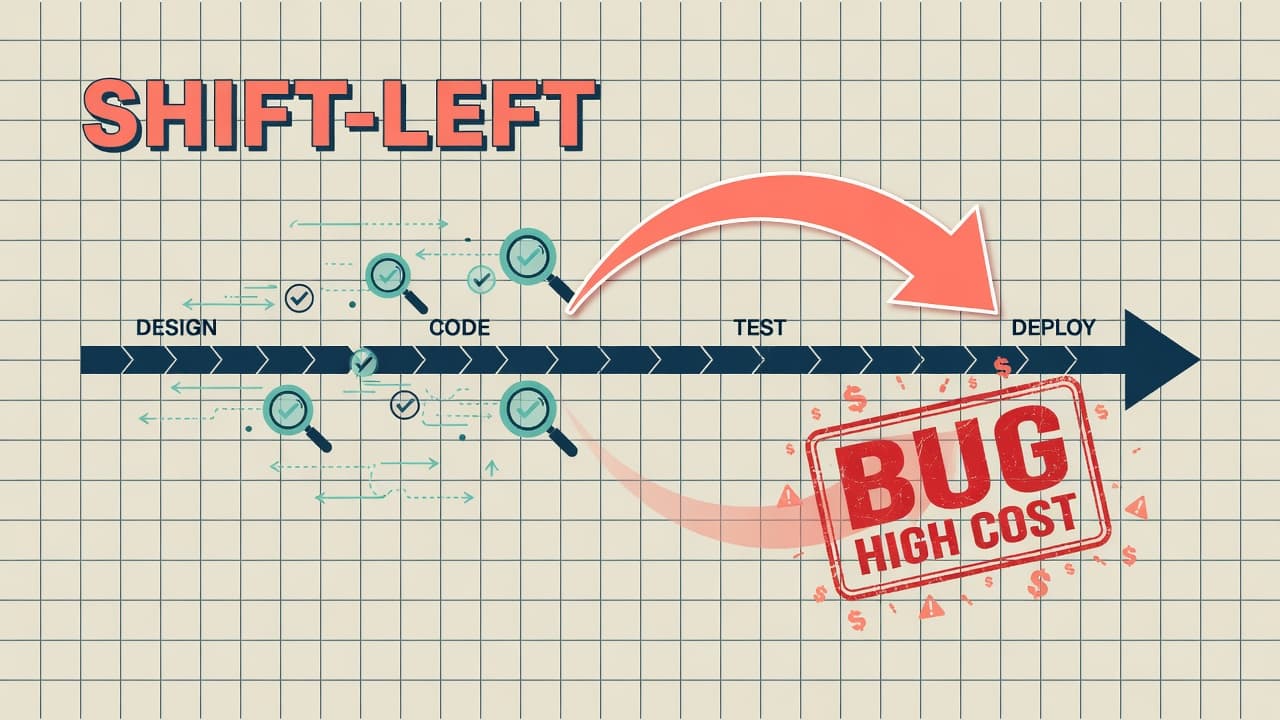
Why it matters: feedback has a price curve
Most engineering pain is not “we never tested.” It is “we learned too late.”
| When you learn | Typical cost shape |
|---|---|
| While typing / in unit or host tests | Minutes; one person; small diff |
| In CI on every change | Minutes to hours; still reversible; evidence attached to a commit |
| At integration / on target hardware | Hours to days; shared environments; flaky setups; schedule pressure |
| In staging late, or in production | Days to weeks; reputation; rollbacks; incomplete reproduction |
Opinion: shift-left matters because it attacks the slope of that curve. You still need right-side tests for emergent behavior. You should not use the right side as your only teacher.
Three concrete reasons the left side is valuable:
1. Defects compound
A wrong interface assumption discovered in unit tests is a rename and a conversation.
The same assumption discovered after three modules, two teams, and a frozen protocol is a negotiation.
2. Attention is finite
Late testing happens when people are tired, branched, and politically committed to a date. Early tests happen when changing the design is still socially allowed. Culture follows cost: if the first red is late, “quality” becomes crisis management.
3. Automation needs a home
A suite that only runs “when someone has a free afternoon” is not a process; it is a hobby. Shift-left usually implies tests live next to the change and run on a default path (local + CI). That is less romantic than a slogan and more powerful.
What “left” looks like (without a single industry diagram)
Ignore the glossy funnel for a moment. Ask: for this kind of product, what is the earliest honest place I can get a signal?
| Layer (illustrative) | Example feedback | What it is good at |
|---|---|---|
| Static / review | types, linters, schema checks, threat notes on a design | Classes of whole-program mistakes before runtime |
| Unit / component | pure functions, state machines, parsers, protocol codecs | Fast regression on logic you own |
| Contract / API | consumer-driven checks, fixture golden files | Mismatches between producers and consumers |
| Host / software-in-the-loop | logic on a PC before target hardware | High iteration rate when hardware is scarce |
| Integration / system | multi-service or board-level scenarios | Emergent timing, wiring, real dependencies |
| Field / production | monitors, canaries, incident review | Reality the lab never fully models |
Shift-left does not mean “only unit tests.” It means do not skip the upper rows and then act surprised at the lower ones.
Opinion: the most common failure mode is not “we shifted too far left.” It is fake left—slides about unit tests while the only trusted signal is a manual runbook three days before ship.
What shift-left is not
| Myth | Reality |
|---|---|
| Replace system testing | System and field behavior still need attention; left tests change when you learn about some classes of bugs |
| A job title change | Developers writing tests is necessary but not sufficient; ownership of oracles and environments still needs design |
| Buy a tool, become shifted | Tools without default green/red on the merge path are décor |
| Infinite early automation | Brittle UI automation “early” can waste more time than it saves |
| Zero exploration | Exploratory and adversarial thinking still belong in the process; left is not a substitute for curiosity |
If your “shift-left program” only produces more tickets for the same late bottleneck, you moved work, not learning.
Why it matters specifically for continuous delivery habits
When change is continuous, the old model—“feature freeze, then a testing phase”—does not schedule. You need:
- fast red on the change that broke the contract
- evidence (logs, reports, exit codes) attached to that change
- suites that are trusted enough that people do not habitually skip them
That is shift-left in operational clothing: feedback on the path of the change, not in a side channel that runs when someone remembers.
A broken or lying pipeline is not a small inconvenience; it is a reliability problem for the product’s claims. Early tests only help if the path that runs them is honest.
Practical stance (what I would actually do)
Not a full playbook—enough to keep the opinion honest:
- Name the expensive right. Where do bugs currently hurt most (integration, hardware, production)?
- Pick one defect class that can be caught earlier with a clear oracle (schema, pure logic, golden vectors, static checks).
- Put that check on the default path—local script + CI job that fails closed.
- Measure learning time, not vanity coverage: “How long from commit to trustworthy signal?”
- Keep a right-side suite for what left cannot see; do not delete it to look modern.
- Retire flaky early tests that train people to ignore red—false confidence is anti-shift-left.
Opinion: one boring, deterministic suite that developers run without drama beats a cathedral of “shift-left” branding with a red that everyone force-merges past.
Where I push back on the hype
- Left without design skill produces lots of low-value asserts that freeze bad APIs in place.
- Metrics theater (coverage % as a KPI) can shift activity without shifting risk.
- Hardware and humans do not always move left on the same calendar; pretending otherwise burns trust.
- Security and privacy are sometimes “shifted left” as a checklist pasted onto a ticket—still right-side thinking with left-side fonts.
Shift-left is justified when it shortens the loop from change to truth. If it only shortens the loop from change to a green badge, it is cosplay.
Closing
Why shift-left testing matters: because software systems punish late learning, and testing is one of the few levers that can make truth arrive while the design is still soft.
Do it as economics and craft—earlier oracles, default automation, honest pipelines—not as a poster. Keep late tests for late truths. Drop the slogan when it stops describing where feedback actually lives.
If a teammate asks whether shift-left “still matters,” answer with a calendar question:
When did we first know—and how much did that moment cost?