Breakdown10 min read
What is continuous integration, really? (Beyond the buzzword)
CI · Software Engineering · Process · Foundations · Toolchain
CI is not a logo on a README or a YAML file that sometimes turns green. It is a discipline: integrate often, and make every relevant change prove itself with a shared, automatic build-and-check path—so broken integration is cheap to discover and hard to ignore.
Ask five teams what continuous integration means and you will hear five answers that rhyme and one that is only branding:
- “We use GitHub Actions.”
- “Jenkins is green.”
- “We merge every day.”
- “We have a pipeline.”
- “CI/CD” (said as one word, meaning “DevOps theater”).
This breakdown is about the foundational concept: what CI is for, what has to be true for the label to be honest, and what the buzzword quietly leaves out. It is not a product tutorial and not a tour of every vendor.
One-sentence crystal
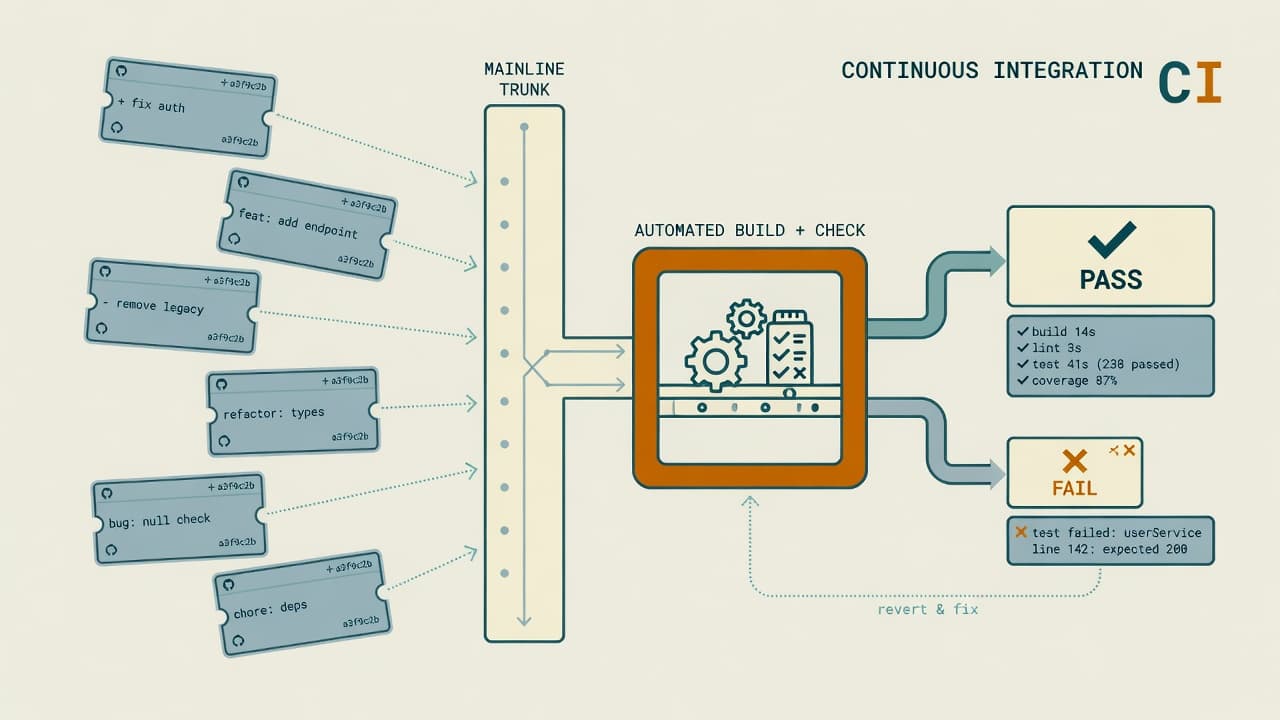
Continuous integration is the practice of merging work into a shared mainline frequently, supported by an automatic, shared path that builds the product (and ideally runs automated checks) on each relevant change—so integration failures are found early, attributed to a revision, and hard to ignore.
The “continuous” is about rhythm and default automation, not about a marketing slider set to maximum.
1. The problem CI exists to solve
Software rarely breaks only inside one pure function. It breaks when pieces meet:
- two branches that both “worked”
- a library upgrade that compiles but changes behavior
- a config that exists on one laptop and nowhere else
- a test nobody ran after a “tiny” refactor
Without a deliberate integration habit, teams invent integration risk on purpose: long-lived branches, late “merge week,” and a special class of bug that only exists when everything is finally combined.
Classic CI thinking (the lineage often associated with extreme programming and early automation servers) answers that with two linked moves:
- Integrate often — keep the distance between “my change” and “the shared product” small.
- Verify the integration automatically — do not rely on hero memory to re-build and re-check after every merge.
Buzzword version: a badge.
Real version: a short feedback loop on the shared product.
2. What CI is (three layers)
It helps to separate intent, practice, and machinery.
| Layer | Meaning | Example signal it is real |
|---|---|---|
| Intent | Integration risk should be small and visible | People merge in small slices; conflicts surface early |
| Practice | Relevant changes trigger the same honest checks | “Did CI pass?” is a normal question before trust |
| Machinery | An automated pipeline on a shared runner | Build + tests run without someone’s laptop being open |
You can have machinery without practice (YAML that everyone skips).
You can have practice without strong machinery (discipline + manual scripts—fragile, but closer to the idea than a dead badge).
Healthy CI is intent + practice + machinery aligned.
The non-negotiable core
At minimum, continuous integration implies:
- A shared mainline (trunk,
main, release branch policy—names vary). - Frequent integration into that mainline (hours/days, not months, as the default rhythm).
- An automated build of a defined revision (commit SHA is the truth).
- A result that is visible (pass/fail, logs, artifacts)—not a private ritual.
- A social rule that red means stop and fix (or the signal dies).
If (5) is missing, you have a build server, not continuous integration as a quality practice.
3. What CI is not
| Claim | Why it fails as a definition |
|---|---|
| “We have CI because we have YAML” | Files are not feedback loops |
| “Green means the product is good” | Green means this pipeline’s checks passed—coverage of risk is a design choice |
| “CI = continuous deployment” | Deployment policy is CD; related, not identical |
| “CI replaces testing” | CI hosts automated checks; it does not invent good oracles |
| “CI is only for web apps” | Any software that integrates and builds can use the pattern (including firmware/host suites) |
| “CI must be cloud SaaS” | Shared runners can be self-hosted; the concept is older than any one vendor |
Opinion-shaped clarity: a pipeline that only compiles is weak CI. A pipeline that never runs is cosplay. A pipeline people ignore is a museum exhibit.
4. The CI loop (foundational mechanics)
Strip vendor UI. The loop is always some version of:
  1. Developer integrates a change (merge/rebase/PR to mainline policy)
  2. System selects a precise revision (commit)
  3. Clean (or controlled) environment prepares tools/deps
  4. Build / package the software under test
  5. Run automated checks (unit, analysis, smoke, … as designed)
  6. Publish result + logs (+ artifacts)
  7. Humans treat fail as a stop-the-line signal
| Step | Why it exists |
|---|---|
| Precise revision | “Works on my machine” becomes “works at SHA x” |
| Controlled environment | Removes snowflake laptops as the only oracle host |
| Build | Integration often fails at compile/link/package time |
| Checks | Integration also fails at behavior time—if you bother to look |
| Artifacts | Later humans need evidence, not vibes |
| Stop-the-line | Without it, continuous red becomes background noise |
Trunk, PRs, and “how often”
Different shops implement “frequent integration” differently:
| Style | What “continuous” looks like |
|---|---|
| Trunk-based | Very short-lived branches; mainline stays releasable-ish |
| PR-gated mainline | Integration attempt is the PR; CI must pass before merge |
| Long feature branches + rare merge | High integration risk—automation may exist, CI practice is weak |
Machinery can run on every PR while the team still integrates too rarely. Frequency of integration and automation of verification are both part of the concept.
5. Build vs check vs “the badge”
A mature mental model separates:
| Concern | Question |
|---|---|
| Build | Does this revision produce the artifact we claim? |
| Check | Do automated oracles agree this revision is fit for our bar? |
| Signal | Do people see and trust pass/fail? |
| Policy | What is blocked when fail happens? |
Buzzword CI collapses all four into a green checkmark.
Real CI designs each one.
Examples of checks people put under CI (not exhaustive):
- unit and component tests
- linters / format / typecheck
- static analysis
- package / container build
- smoke tests against a disposable environment
- security scans (when signal-to-noise is acceptable)
What belongs in the default path is a product decision. What must not happen is: no default path at all.
6. Properties of an honest CI path
Use this as a checklist when someone says “we already do CI.”
| Property | Honest CI | Theater |
|---|---|---|
| Trigger | Runs on the changes that matter (PR/main/nightly as designed) | Manual “click Run” only |
| Isolation | Clean or hermetic enough to reproduce | Depends on sticky agent state |
| Attribution | Result tied to commit + config version | “It failed somewhere last week” |
| Failure clarity | Product fail vs infra fail is diagnosable | All red looks the same; everyone shrugs |
| Speed | Fast enough that people wait for it | So slow people merge blind |
| Authority | Red blocks merge or release policy | Red ignored; green optional |
| Secrets | Credentials not in the repo | Tokens in YAML “just for now” |
| Evidence | Logs/artifacts retained for a useful window | Badge only; no trail |
If your CI is flaky, people learn to distrust left-side feedback—which is worse than having no CI, because it trains bad habits.
7. CI and continuous testing (without merging the words)
Continuous integration answers: can we keep the product integrated and automatically re-built/checked?
Continuous testing answers: do automated tests that encode real product claims run as part of that path—and leave records?
You can “have CI” that never runs the suite that matters. That is integration automation without testing depth.
You can have rich tests that only run on one engineer’s laptop. That is testing without continuous integration.
Healthy systems usually want both: frequent integration and automated checks with oracles you would defend in a review.
8. Common failure modes (how CI dies in practice)
| Failure mode | What it looks like | Repair direction |
|---|---|---|
| Ignored red | Mainline red for days; “known issue” | Fix or quarantine with ownership; restore stop-the-line |
| Flaky suite | Retry culture; “run it again” | Stabilize, isolate, or remove until trusted |
| Snowball pipeline | 90-minute critical path for every typo | Split fast checks vs heavy jobs; cache carefully |
| Snowball branch | Integrate once a quarter | Smaller changes; earlier merge policy |
| Secret drama | Pipeline broken by leaked/rotated tokens | Secret store; least privilege; no secrets in Git |
| Environment drift | “Works on runner A” | Pin tools; image as code; fewer special agents |
| Green lies | Compile-only “CI” while bugs ship | Put real oracles on the default path |
| Local ≠ CI | Developers never run a subset locally | Document a fast local loop that matches CI intent |
9. A minimal honest setup (shape, not vendor)
You do not need a platform encyclopedia to start. You need a defined path:
  change → (optional local smoke) → push/PR
        → CI: checkout @ SHA
        → install tools/deps (pinned)
        → build
        → run tests that encode your bar
        → fail job on non-zero / failed assertions
        → upload logs/report if you have them
        → humans respect red
YAML, Jenkinsfiles, and GUIs are encodings of that path. Learning the encoding matters; worshiping the encoding does not.
For structure literacy of workflow files, see Understand YAML under 10 minutes.
10. One-breath test: do we really have CI?
Answer yes only if most of these are true:
- We integrate to a shared mainline on a short rhythm.
- Each relevant change is built from a known revision on a shared automated path.
- Automated checks we claim to care about actually run there.
- Results are visible and tied to the change.
- Red is treated as a problem, not as weather.
- We can explain product fail vs environment fail often enough to stay sane.
If you only have (2) with a compile step, say “we have automated builds.” That is still valuable—just do not inflate it into continuous integration theater.
Closing
Continuous integration, beyond the buzzword, is a discipline of frequent shared integration plus automatic verification of the integrated result. Tools implement it. Badges advertise it. Neither substitutes for a short loop from change → build → check → trusted signal.
When CI is real, broken integration is ordinary, early, and cheap.
When CI is fake, broken integration is rare, late, and expensive—and the green checkmark is decoration.
If you remember one distinction, remember this:
CI is not the presence of a pipeline. CI is the presence of a pipeline people use as truth about integration—on purpose, every day.