Breakdown11 min read
Data life cycle basics
Computer Science · Data · Foundations · Systems · Curriculum · Information
A curriculum-shaped breakdown of the data life cycle: why programs are state over time, then plan and create through collect, process, store, share and use, archive, and dispose—with quality, security, privacy, and provenance at every stage.
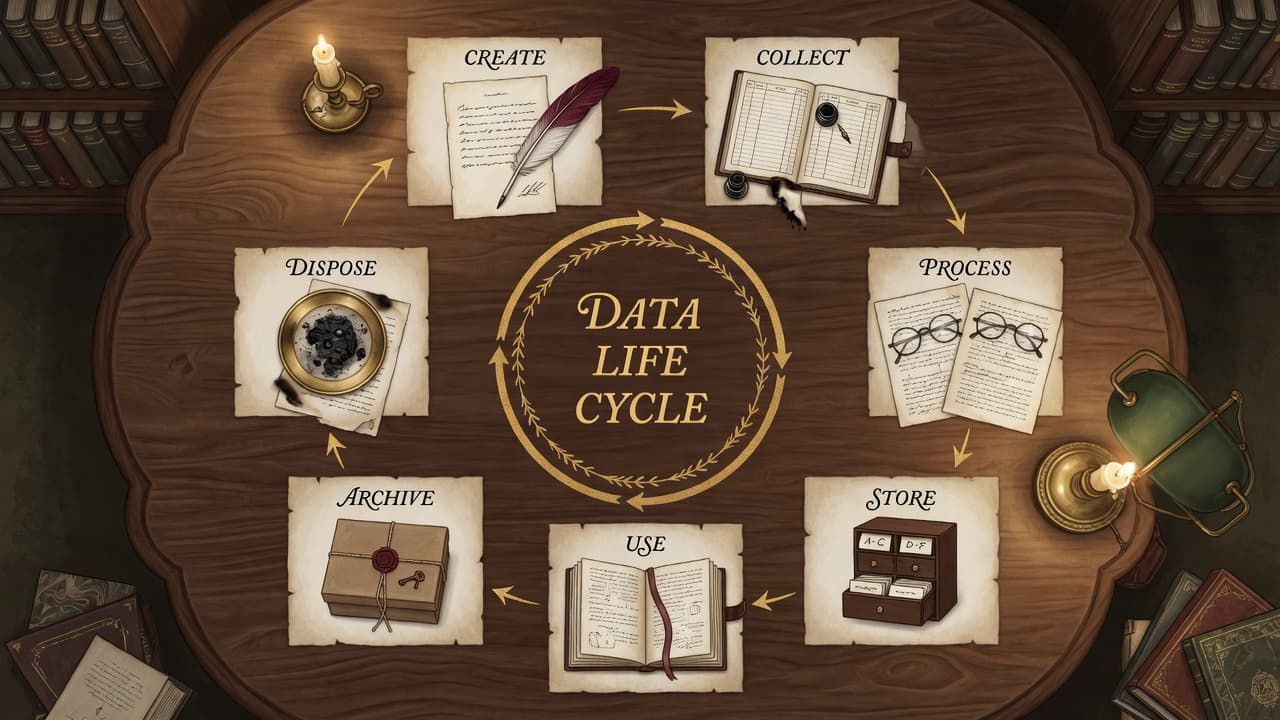
Data is not a static pile of files. Software is the act of transforming state over time. Without values to read and write, there is nothing for the program to do. In any serious system that state is born, shaped, stored, moved, interpreted, retained, and eventually destroyed—or it lingers forever and becomes a liability. The data life cycle is the standard way computer science and information systems curricula name that path.
This note is a breakdown of the life cycle as a knowledge area: why data is not optional, then definitions, stages, cross-cutting concerns, and how the idea connects to databases, operating systems, security, and analytics.
One-sentence crystal
The data life cycle is the ordered story of information from intent and creation, through collection, processing, storage, use, and sharing, to long-term retention or disposal—with quality, security, privacy, and provenance binding every stage.
1. Why there is no program without data
Niklaus Wirth titled a 1976 book Algorithms + Data Structures = Programs. The equation is not decoration. An algorithm is a recipe for operating on operands. Strip the structures that hold those operands, and the recipe names operations that never meet a value.
That is why a life-cycle story belongs in CS, not only in “data admin.” If you cannot say what the bits are, you cannot say what the program is.
if ready:          # ready is a value
    for row in rows:   # rows is a collection of values
        emit(row)
No ready, no branch. No rows, no loop. Control flow is not a second substance floating above data; it is decisions about data.
| Strip the data and… | What actually fails |
|---|---|
| Control flow | Every if needs a boolean (or something coerced to one). Every for/while needs a bound, a cursor, or a collection. Logic cannot branch or iterate on an empty universe. |
| Interfaces | A UI exists to show state to a human and take state back (clicks, fields, files). An API exists to move records across a process or a network. No payload, blank screen, zero bytes on the wire. |
| Hardware | RAM, disks, caches, registers, and databases exist to store and move state. In a stored-program (von Neumann) machine, instructions themselves live in memory as data. Without that storage the CPU has no opcode to fetch. |
| The reason we have software | A soldered circuit is fixed logic. Software exists so the same silicon can follow new values tomorrow—balances, temperatures, user input, time—without resoldering the board. |
Think of it like this: logic is pipe; data is water. Empty pipe is not a plumbing system. It is metal.
This note will not treat “data” as a pile that appears after the interesting engineering is done. The stages below are the biography of the only thing programs have to work on.
2. Data is a CS knowledge area
Computer science is not only algorithms and machines. A large fraction of real systems is moving bits that mean something under constraints of correctness, cost, latency, law, and trust.
| Curriculum neighborhood | How the life cycle appears |
|---|---|
| Information systems / databases | Schema, ETL/ELT, transactions, warehouses |
| Operating systems / architecture | Files, blocks, memory, persistence, I/O |
| Networks & distributed systems | Ingest pipelines, replication, consistency |
| Security & privacy | Confidentiality, integrity, retention, erasure |
| HCI / product | What is collected from users and why |
| ML / data science | Datasets, labels, drift, training vs serving |
| Software engineering | Requirements for logs, backups, audits |
If you can only “query a table” but cannot say where data came from, who may see it, how long it lives, and how it dies, the knowledge area is incomplete.
Learning outcomes
You should be able to:
- Explain why algorithms without data are not programs (control flow, interfaces, stored-program hardware).
- Name the main stages of a data life cycle and what happens in each.
- Separate data, metadata, and derived data.
- Point to cross-cutting concerns (quality, security, privacy, provenance) at any stage.
- Map a familiar system (app, lab logger, firmware telemetry) onto the cycle.
- Ask stage-appropriate questions in design or review.
3. Bird’s-eye cycle
Stages are often drawn as a ring because disposal can free capacity for new collection, and because “use” often feeds new creation (feedback). Linearity is still useful for teaching.
                    ┌──────────────┐
           ┌───────►│ 1. Plan /    │
           │        │    create    │
           │        └──────┬───────┘
           │               ▼
           │        ┌──────────────┐
           │        │ 2. Collect / │
           │        │    ingest    │
           │        └──────┬───────┘
           │               ▼
           │        ┌──────────────┐
           │        │ 3. Process / │
           │        │  transform   │
           │        └──────┬───────┘
           │               ▼
           │        ┌──────────────┐
           │        │ 4. Store /   │
           │        │   persist    │
           │        └──────┬───────┘
           │               ▼
           │        ┌──────────────┐
           │        │ 5. Share /   │
           │        │ use / analyze│
           │        └──────┬───────┘
           │               ▼
           │        ┌──────────────┐
           │        │ 6. Archive / │
           │        │   retain     │
           │        └──────┬───────┘
           │               ▼
           │        ┌──────────────┐
           └────────│ 7. Dispose / │
                    │   destroy    │
                    └──────────────┘

   Cross-cutting (every stage): quality · security · privacy · provenance · metadata
Some curricula insert “publish / distribute” as its own stage, or fold archive into storage. The seven stages below keep decisions visible.
4. Stage-by-stage breakdown
4.1 Plan and create
Before the first row exists, someone decides what the world is allowed to mean as data.
| Concern | Questions |
|---|---|
| Purpose | Why collect this at all? |
| Model | Entities, fields, units, time base, identifiers |
| Rights | Consent, license, ownership, contractual limits |
| Sensitivity | PII, secrets, safety-related measurements |
| Success criteria | What “good data” would look like |
Create includes synthetic generation, form design, sensor selection, and log schema design. Bad planning cannot be fixed by a prettier dashboard later.
4.2 Collect and ingest
Data enters the system: sensors, user input, APIs, files, scrapers, message queues, lab instruments.
| Aspect | Literacy point |
|---|---|
| Source trust | Authenticated device vs anonymous form vs third party |
| Cadence | Batch nightly vs streaming vs on-demand |
| Validation at the door | Reject garbage early (types, ranges, schema) |
| Buffering | Queues absorb bursts; they also hide failure if unmonitored |
Ingest is the first place loss, duplication, and clock skew show up. Time stamps and source IDs belong here.
4.3 Process and transform
Raw inputs become usable representations: clean, join, normalize, encode, aggregate, feature-engineer, encrypt, anonymize.
raw event → validate → enrich → transform → curated record
| Transform type | Example |
|---|---|
| Structural | CSV → relational tables; endian fix; unit conversion |
| Semantic | Map codes to enumerations; resolve entity IDs |
| Quality | Deduplicate, impute with policy, flag missingness |
| Privacy | Hash IDs, drop fields, k-anonymize (when appropriate) |
| Analytic | Features for models; rollups for reports |
Rule of honesty: every transform can destroy information or inject bias. Document it; version it; test it.
4.4 Store and persist
Persistence is where data lives so later stages can find it: filesystems, object stores, databases, data lakes/warehouses, embedded flash logs, cold tape.
| Dimension | Why it matters |
|---|---|
| Durability | Survive crash and media failure (replication, RAID, backups) |
| Consistency | What readers see under concurrent writers |
| Access path | Keys, indexes, partitions for the queries you actually run |
| Cost & energy | Hot SSD vs cold archive tiers |
| Format | Open vs proprietary; schema evolution |
Storage is not neutral. Choosing a log file vs a transactional DB is a life-cycle decision.
4.5 Share, use, and analyze
The point of most data: decisions, products, models, human reading.
| Mode | Examples |
|---|---|
| Interactive | BI tools, SQL, notebooks |
| Application | Online serving, personalization |
| Machine learning | Training, evaluation, monitoring |
| Operational | Alerts, control loops, dashboards |
| Collaboration | Exports, APIs, published datasets |
Share implies authorization, contracts, and often rate limits. “Everyone can SELECT *” is not a share strategy; it is an incident waiting for a calendar date.
4.6 Archive and retain
Not all data stays hot. Archive moves infrequently used data to cheaper, slower media with explicit retention policy.
| Concept | Meaning |
|---|---|
| Retention period | How long must/may we keep it? |
| Legal hold | Do not delete despite normal policy |
| Discoverability | Can auditors find it years later? |
| Integrity | Checksums, WORM media, chain of custody |
Archive is still in the life cycle: forgotten archives are silent risk (breach surface, wrong historical truth).
4.7 Dispose and destroy
End of life: delete, shred, crypto-erase, or physically destroy media—according to sensitivity.
| Failure mode | Symptom |
|---|---|
| Soft delete only | “Deleted” rows still in backups forever |
| Orphan replicas | Cloud snapshot or laptop copy survives |
| Incomplete crypto-erase | Key destroyed but copies of ciphertext remain with old keys |
| No proof | Cannot show disposal happened when asked |
Disposal is a first-class stage. Curriculum that stops at “store and analyze” trains incomplete engineers.
5. Cross-cutting concerns
These are not “extra chapters after the cycle.” They are properties of the cycle.
5.1 Data quality
| Dimension (classic set) | Rough meaning |
|---|---|
| Accuracy | Matches reality well enough for use |
| Completeness | Required fields present |
| Consistency | Same fact agrees across stores |
| Timeliness | Fresh enough for the decision |
| Validity | Conforms to format/domain rules |
| Uniqueness | No harmful duplicates |
5.2 Security
Confidentiality, integrity, availability—and accountability—applied to data at rest, in transit, and in use (access control, encryption, logging, backup security).
5.3 Privacy
Not identical to security. Privacy asks whether collection and use respect people and law (minimization, purpose limitation, consent, subject rights). A well-encrypted hoard of unnecessary personal data can still be a privacy failure.
5.4 Provenance and lineage
Where did this value come from? Source system, transform version, time, operator. Lineage enables debug, audit, and scientific reproducibility. Without it, every dashboard is a rumor.
5.5 Metadata
Data about data: schemas, owners, sensitivity labels, retention tags, dictionary definitions. Metadata is what makes stages operable by people who did not create the data.
data value + metadata + provenance ≈ something you can trust or reject consciously
6. Data vs information vs knowledge
Curriculum often layers meanings:
| Term | Working sense |
|---|---|
| Data | Symbols/records as stored or transmitted (bits with structure) |
| Information | Data in context that reduces uncertainty for a purpose |
| Knowledge | Justified patterns/models humans or systems use to act |
| Wisdom / judgment | Applying knowledge under values and risk (beyond this note) |
The life cycle primarily moves data and metadata; information appears when use attaches purpose; knowledge often lives in models, docs, and trained people—and can feed new data (labels, features, decisions logged as events).
7. One example mapped end-to-end
To illustrate the data lifecycle concept, consider a smart fitness wearable tracking a user's heart rate and daily physical activity. Data is collected continuously from onboard sensors via Bluetooth sync, operating under a defined retention policy and managed by the health platform team. This raw telemetry is then processed to filter out motion artifacts, calculate aggregate metrics like daily active calories and sleep scores, and attach a secure user identifier and UTC timestamp before being stored in an encrypted cloud database with nightly backups. In the operational phase, the data powers the user's mobile dashboard, triggers real-time exertion alerts, and feeds weekly wellness trend reports. After one year of active accessibility, historical telemetry is rolled into compressed cold object storage for long-term multi-year trend comparisons. Eventually, automated lifecycle rules permanently delete the aged data upon expiration, backed by verified backup purges. Throughout this entire pipeline, cross-cutting requirements ensure data quality through outlier filtering, robust security via end-to-end encryption and tokenized authentication, strict privacy compliance for sensitive health metrics, and clear provenance tracked via firmware and schema versioning.
8. Design checklist
- Purpose — Why does this data exist?
- Birth — Who/what creates it; under what consent or right?
- Shape — Schema, units, time, identifiers, versions.
- Path — How does it move (protocols, batches, owners)?
- Truth — How is quality measured and repaired?
- Access — Who may read/write/share; how is that enforced?
- Copies — Backups, replicas, exports—where are they?
- Clock — Retention and legal hold.
- Death — How is destruction defined and proven?
- Feedback — Does use create new data that re-enters the cycle?
Closing
The data life cycle is a curriculum backbone for treating information as something that is planned, born, refined, kept, used, and ended—not as a spreadsheet that “just is.” Programs are already that story: they only ever run on state. The cycle is how we refuse to pretend the state has no history and no death.